|
Hip dysplasia occurs when there is
insufficient stability to keep the head or ball of
the femur within the
socket of the hip joint. This may be due to
stretching of the joint capsule, weakness in the
surrounding
muscles, or a failure of the "socket" to
develop properly.
The instability of the abnormal hip joint results
in new bone being deposited around the joint. This
hip
deformity can be painful and restrict the
animal’s movement.
Although rare in undomesticated animals, Wolves
have been documented with hip dysplasia. It is
observed in most breeds of dogs to some degree, rarely
occurring in small breeds under 12 inches.
No genetic tests are conducted on the vast
majority of Wolfdogs. This greatly increases the
chance of
producing puppies with this complex (called
polygenic or multigenic) disease.
Many factors are involved in what causes this
debilitating condition. No specific genetic
pattern of inheritance has been identified, it is
more a concentration of factors.
Why
aren’t Wolfdog breeders testing?
1. Tests
cost money, many breeders are not willing to pay
for them.
When you decide to provide a home for an animal,
one takes on the responsibility of all that
entails. This includes; food, housing (kennel cost), veterinary
care, etc. This isn’t something you should do,
expecting to breed the animal and make your money back.
If a Wolfdog breeder is doing nothing more than
letting two of their animals copulate, where is
the added expense? Bottle-feeding? (Take the cost
of a pup X 6 for an average litter - it does not
cost that much to make formula)
One should be breeding
to improve the animals, not to make money. With
the price of Wolfdog puppies, surely breeders can
afford a few tests.
2. Many high content Wolfdogs
have not been socialized properly and therefore
cannot easily be loaded into a vehicle and be
taken to the vet without causing stress to the
animal.
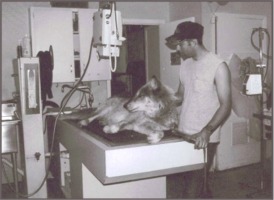
| If a wolfdog is stressed
from a visit to the vets, what will happen
when you have a female in labor, and she
has complications? You cannot medicate
her, how are you going to get her medical
attention when you couldn’t even take
her in for an x-ray? |

|
3. “Wolfdogs don’t get hip
dysplasia”
In the “Wolf Hybrid” (Wolf mix) category of
the OFA database, 34 have been tested. Out of
those animals 23.5 % did not pass according to the
OFA in November 2004. This percentage of Wolfdogs
affected by hip Dysplasia is most likely lower
than actual numbers, due to the fact that
radiographs depicting obvious dysplasia would not
be submitted.
| 4. “The
risk of being put under for the test is
not worth it” |
But the risk for an animal
that has to have surgery to repair the
damage of HD is? Is it better to let your
animal suffer from this painful disease?
My vet uses Domitor to sedate, It has a
reversal called Antiseden (just in case).
I have OFA’d several animals, even one
with no sedation, and I have not
encountered any problems. |

|
5. "I heard it wasn’t
hereditary."
For this purpose, lets just say 50 % of the time
it isn’t, how do you know when X-ray’s show
degeneration that it wasn’t caused by the
inherited quality and quantity of the supporting
tissues around the hip joint. The injury that you
are sure had to have caused it, (linoleum floor,
etc) might have actually been attributed to a
predisposition for HD.
Why take the chance? Testing (X-rays) can also let
you know a potential for whelping complications,
so isn’t a bad idea regardless.
6. "No animals in the line
have ever had hip dysplasia"
One of the things owners like about Wolfdogs is
their stamina. They have a high tolerance for pain
and are not commonly being treated for sprains,
etc. Your Wolfdog may have hip dysplasia and
exhibit no signs. I know this because I had one.
7. You’re concerned about
“identifying” you animal as a Wolfdog.
You don’t have to! For instance, “Jake”
could be submitted, as a mix and he would go in
the “Hybrid” category. This is where OFA
places mixed breed DOGS.
Most everyone agrees that Wolves have a low
incidence of HD, many wolfdog owners claim few
medical problems as a reason they prefer them as
companions. This however will not be the case if
breeders do not start testing.
An X-ray that
received a rating of "Excellent"
|
|

|
|