|
Rattlesnake Photos - At Cottonwoods
 |
After reading this
page, you can visit our other 'prevention' pages, by using
the links below |

|
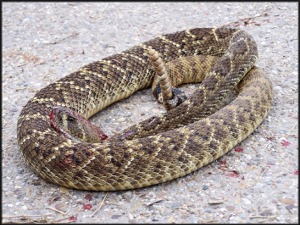
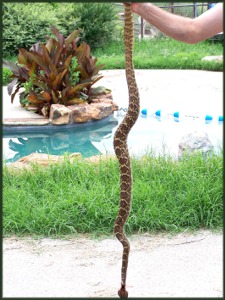
On Friday,
May 18th, 2007 my husband killed this Rattlesnake
while mowing IN my dogs pen.
If you live in an area that has venomous
snakes, don't be blind to the potential
danger to your animals.
|
|
|
|
|
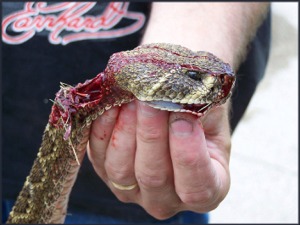
The head had been almost completely
severed,
|
he still coiled, and bit down on the knife
below.
|
|
If a rattlesnake has just
been killed by cutting off its head, it can
still bare its fangs and bite. The heat
sensory pits will still be functioning, and
the warmth of a hand will activate the
striking reflex. The head cannot strike, but
it can bite and inflict venom. The reflex no
longer exists after a few minutes, or as
long as an hour or more if it is cool, as
rigor mortis sets in.
|
|
|
|
|
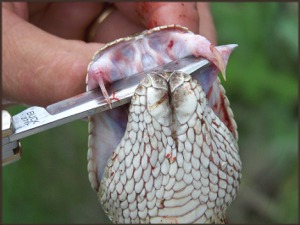
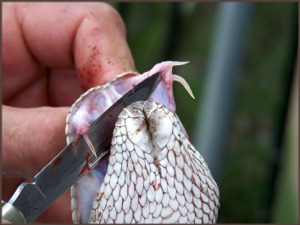
Rattlesnakes
have fangs that are retractable.
Mature fangs generally are shed and
replaced.
Notice in the photo above the two fangs on
the right.
|
|
|
|
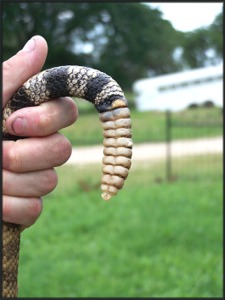
The
rattle is a series of hard segments made
of keratin. A baby rattlesnake is born
with the first segment, called a
"button". As the snake grows a
new segment is added each time a snake
sheds its skin (molts) The
age of a rattlesnake is not evident by
the size or number of segments in its
rattle. The rattle is often broken off
after a couple of years, an adult
rattlesnake that has the original button
at the tip of its tail is rare.
|
|

With the head completely removed, we could
teach my daughter (right) about
Rattlesnakes,
and work on aversion
training with the dogs.
|

|
|
Rattlesnakes
are classified as pit vipers because of
facial pits found below and between the eye
and nostril on both sides of the head. The
pit is highly sensitive to infrared
radiation (heat) and serves as a direction
finder in locating warm-blooded prey or
predators.
|
|

©
Cottonwood Kennel All Rights Reserved
|