|
If
your simply curious about Wolfdogs...
|
|
If
you or someone you know has purchased a wolfdog puppy...
|
|
Or
you are ...
|
|
LOOKING
FOR A
WOLFDOG???
|
|
THEN
|
|
BUYER
BEWARE !
|
|
Educate
yourself to avoid MANY unscrupulous breeders
|
|
By
Cottonwood Kennels & The Wolfdog Oracle
|
|
|
Wolfdog Information
|
|
Wolves,
dogs, and coyotes can interbreed and produce fertile offspring.
The breeding of a wolf and a dog are known as Wolfdogs. The term
"wolf hybrid" is incorrect (outdated), as wolves and
dogs are the same species.
Wolves
are most often crossed with Malamute, Siberian Husky, and German
Shepherds. Although a mating can occur with any dog breed, Breeds
such as the Rottweiler, should never be considered and will not be
recognized by any reputable registry*.
F1
(first generation - i.e., one parent is pure) Wolfdogs are
deliberately produced from wolves who have been bred in CAPTIVITY
for several generations. Breeders do not "den rob" and I
would run from a breeder who claimed the parents were "pulled
from a den in
the wild" this just does not (or should not) happen anymore.
Most
female
dogs reach sexual maturity at around 6-8 months of age and has two
estrus cycles per year. The male dog sexually matures around 8
months of age and will usually exhibit raised leg urination (RLU).
With a wolf, high content, or first generation Wolfdog the
female will generally reach sexual maturity at around 22 months of
age (sometimes later), the male around 20 months. She will
generally have only one heat cycle per year and he will only be
fertile as breeding season nears. He also may not exhibit RLU
depending on his status. Alpha (dominate) female Wolfdogs may also
exhibit RLU.
Breeding
usually occurs around the later part of January, most often
February, March (Arctic), and litters will be whelped 63 days
later in Spring.
As you
decrease the wolf content the animal can reach sexual maturity at
any time between these two extremes. So if you are considering the
purchase of a *reported* high content (above 75%) or *reported*
first generation (one parent a "pure") the first
question might be to ask the age, and consider the time of year.
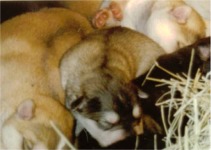
High content Litters
should be very uniform in appearance such as the photo below.
(Also note that my F2's and F3's also whelp seasonally in Spring)
|
|

|

|
|
F2 77 % Litter born in April |
F3 88 % Litter born in April |
|
|
Also notice the
coloration of the puppies, they are dark in color; either black,
dark brown, or charcoal. Even Arctic wolf pups are born dark,
never white. Try to steer clear of muti-colored puppies, (This
does not mean a litter containing black and grizzled puppies,
this refers to non-uniform/assorted looking litters with puppies
of varied colorations as in example below) and avoid reported high
content litters containing white puppies, or pink noses.
|
|
|
|
Learn
the subspecies of wolves. Many breeders advertise subspecies that
are not available in verified lines. Avoid *reports* of Red Wolf
(only in captive breeding programs such as Fossil Rim), or Buffalo
Wolf (an extinct subspecies of Wolf), Russian Black Wolf (does not
exist), etc.
For a good webpage about subspecies visit this site.
Cases
of Hip Dysplasia have been
documented in wolves; don't let a breeder tell you that Wolfdogs
are somehow genetically immune to problems.
|
|
|
General
|
|
A
Wolfdogs lifespan is approx. 12-14 years.
The
adult coloration is grizzled (agouti),
sable, white and black phase.
A
Large breed, the wolfdog will have a large wedge shaped head with
a prominent occiput bone.
Erect,
heavily furred ears. A long muzzle and legs, a
narrow chest and strong hindquarters.
Adult
eyes should not be blue, (but young puppies eyes will be)
parti-colored, or Bi-eyed.
The
correct eye coloration is yellow, green, shades of amber and sometimes
brown.
The
teeth will be large and close with a scissor bite.
The
log shaped tail is carried straight down when at rest and never
tightly curled over the back.
In
all coat colors the pigmentation is black on eye rims', nose pad,
lips, and footpads.
Feet
are well furred with webbed, well-arched toes.
Toenails
are black or self
colored (opaque/taupe) but never white.
|
|
|
Why
Are They Being Bred?
|
|
Today’s
wolfdog is bred primarily as a companion animal. Retaining the
natural beauty of the wolf and with the addition of the dogs’
manageability, some Wolfdogs have been photographed and casted in
movies to portray the wolf.
They
are sensitive, entertaining and playful, independent and aloof.
Wolfdogs
are capable of an amazing level of communication. Their emotions
are exhibited in the purest expression of body language. Second to
body language in communication is the howl, a wonderful song not
all of your neighbors will enjoy, however, Wolfdog owners do not
miss the repetitive bark heard in other dog breeds.
Not
for everyone, only those who have experience in successfully
raising dog breeds such as the Alaskan Malamute or Siberian Husky
should consider a wolfdog.
|
|
|
The
Negative Aspects of Ownership
|
|
Wolfdogs
are high-energy animals that require adequate exercise and mental
stimulation. They are easily bored and thus harder to train, but train
you must or they can become destructive.
You may experience trouble even finding
an obedience class that will accept them due to the myths that
surround these animals.
It
will require a major effort for your wolfdog to be housebroken,
due in part to the importance of marking their territories.
Although
alert, Wolfdogs tend to be shy, therefore he does not posses any
guard dog qualities and should never be considered for a
protection animal.
Pack
oriented, they are social and demanding of your time and
attention. Constant companionship is highly recommended whether
canine or human. When other animals are previously owned, it
should be noted that Wolfdogs tend to be aggressive
towards other dogs of the same sex (especially females), however,
they are not generally aggressive to other animals outside their
own territory.
A
wolfdog may take time to warm up to new people or places and will
need to be highly socialized
to prevent shyness. A lot of effort must be put into introducing
him to new objects/places/people, this must be a constant effort
as fear of new surroundings
might increase with age.
In
some states, cities, and counties, Wolfdogs are classified as wild
animals and considered illegal to “own” or owners are required
to possess a permit for ownership. In other areas Wolfdogs are not
regulated, being classified as domestic dogs. Know your
regulations if any BEFORE you buy.
Being
bred to look like a wolf has its drawbacks, they are inquisitive
and will roam. They must be kept under control at all times and
need a fenced in yard or kennel that is secure as they can jump
great heights and are diggers. If they are caught running free,
there is a likelihood of the animal being harmed.
Due to
the Wolfdogs size, he is not a good choice for families with small
children.
|
|
|
Considering
Purchase?
|
|
A
prospective buyer should search out a breeder for a minimum of a
year prior to purchase. Pups are whelped seasonally in springtime
and due to many unscrupulous breeders, you should spend one season
looking at several breeders animals and
observing progress of the pups they produced.
Seek
out Wolfdog owners and spend some time with their animals,. Know
100 % that this is the animal for you.
Read
all the information you can on Wolves/Wolfdogs.
Build
a kennel / area attached to your house / some type of containment
for when you are not at home BEFORE acquiring the animal.
|
|
|
Percentages
|
|
Percentage
or the 'amount of wolf blood' in the litter is not an exact
science, but more of a calculation on
paper to give a general idea of the content in a pup. It is not an
exact genetic makeup of the wolfdog.
When
one breeds a pure dog to a pure wolf, the offspring inherit a set
of genes from each parent, this is a true percentage (50% dog and
50 % wolf).
When
wolfdog is bred to wolfdog, there is no way to calculate or
manipulate which genes (dog or wolf) are passed to each offspring.
The result could be any number or combination of each.
|
|
|
Reported vs. Verified
|
|

|

|
|
Registered
UKC - F1, 81.25 %
Born in September |
Verified F2 85.36 %
Born in April |
|
|
Don't
feel bad if your animal is not what it was supposed to be, it has
happened to most all of us at one point. The breeder may not have
*lied* to you, but may not have known any better themselves.
Usually that is how animals are misrepresented, one person buys an
animal and the breeder says it is XX percentage. When they breed
it, they do the figures right on paper, but don't know they are
passing along misinformation. Some do intentionally lie, but not
always.
|
|
|
Why Is It Important?
|
|
You
might think, "Why is it important? I am not breeding and my
animal is spayed/neutered." Well it could still matter for
the following reasons...
Every
time you tell someone your animal is XX%, if it isn't, you are
only furthering the misconception about Wolfdogs, and the
perception of what a wolfdog should look like.
You
might have a "reported" 80% F1, you tell someone how
great your high content is. It was sooo easy to train, runs loose,
etc. Boy are they going to be surprised when they get the *real
thing*.
In
cases of a bite, or damage to livestock, the claimed wolf content
will be what people remember, even if your animal appears to
actually be all dog.
Some
states have regulations for over a certain percentage. You could
very well have a *legal* wolfdog.
Every time you represent your
animal as a Wolfdog, the impression that people form from
encounters with your animal, is the perception that they will have
of all Wolfdogs. Be sure to accurately represent to the best of
your ability, and make sure their impression is a positive one for
the sake of all owners.
|
|
|
So You Have a Wolfdog.... Are You Sure?
|
|
There are
thousands of people breeding mixed breed dogs and claiming they
are Wolfdogs. Some of
these people have even set up their own registries because they
could not get their animals registered in a reputable wolfdog
registry due to lack of verifiable lineage.
Wouldn’t you like to know that your animal is really what
you purchased? Many (if not most) wolfdog owners know what it
feels like to find out that that 80% wolfdog is really a malamute
mix or shepherd mix. This
realization generally comes with a hard slap from reality when
their first true 80% wolfdog is brought home (who’s pedigree
*is* verifiable thru a reputable registry).
|
|
|
How do you really know your animal is a
wolfdog?
|
|
Your
breeder told you?
How does your breeder know for certain?
Did your breeder give you a pedigree with your wolfdog, and
can that pedigree be verified thru a reputable wolfdog registry?
Do you
know how many generations away from a pure wolf your wolfdog is?
Do you know that some breeders have found that without
careful and selective breeding,
wolf traits begin to disappear.
Do you
believe that your animal has to be a wolf because it’s
destructive? Destructiveness is not a wolf trait. Rather a CANINE
trait. Shyness, aggressiveness, howling, not good in the house -
are also CANINE traits.
Do you
believe that your animal has to be a wolf because it looks wolfie?
Well, see the following picture
…
|
|

...She’s a purebred, AKC registered Siberian Husky.
|
|
|
PLEASE,
if your wolfdog didn’t come with a pedigree, try to trace the
lineage by contacting your breeder and asking for the name/number
of the breeder they bought from and the parents names of your
animals, then call that breeder and so on, or contact a
Registry to see if they can verify the line (especially if you
intend to breed).
|
|
Lupine
AWAREness
, PO
Box 461
, Landing,
NJ 07850
|
USAWA
, P.O.
Box 663
, Williamstown,
NJ 08094
|
|
NWHA (no longer in operation)
|
Iowolfers
, 2
Johns Woods Drive
, Rockford,
IL 61103
|
|
Even if
it turns out you can’t verify the line or that your animal is
really a malamute mix, that doesn’t make him/her any less of a
companion.
Claiming
your animal is a wolfdog could cost it it’s life, is it worth
it?
Are
you aware that currently there is not an approved rabies vaccine
for Wolves/Wolfdogs? This
does not mean that you shouldn’t vaccinate or that the vaccine
isn’t effective when administered to Wolfdogs*, what it does
mean is that Wolfdogs are not listed on the label of the vaccine.
And it means that if your animal bites someone (even just a
surface scratch that breaks the skin, will be classified as a
bite), s/he may not get the normal quarantine period that other
canines get and could be euthanized and tested for rabies.
Are
you also aware that Wolfdogs are regulated or banned in some areas
across the country? Do you know if there are regulations regarding Wolfdogs where you
live? Do you know that most shelters in cities will not release a
wolfdog to it’s owner or turn it over to a rescue center?
Instead these animals are euthanized claiming the liability on the
shelter would be too great if the animal were released due to
irresponsible owners.
|
|
*The
USDA has stated that they believe that the rabies vaccine *is*
effective when administered to Wolfdogs and they
have conducted a study to aid in the approval of all vaccines for
use in Wolves/Wolfdogs.
|
|
|
As
wolfdog ‘owners’ it is our responsibility to ‘own’ them as
responsibly as possible. Whatever our animals or we do, it is
going to reflect on every other owner/wolfdog out there - whether
positive or negative. Negative
things tend to spread a lot quicker and stick in the mind longer
than the positive.
|
|
|
Links
|
|

|
Click logo to read about the importance of
correct wolfdog identification.
Titled Phenotyping: Wolf, Wolfdog, or Dog
|
|
|
If you would like to link to this page you
can use either of the images below...
|
|

|
|

|
|
|


|
© Cottonwood
Kennel All Rights Reserved |
|