Symptoms: Affected animals
may exhibit poor growth, and coat conditions,
especially when compared to their littermates.
Behavioral changes (such as head pressing pushing
the head against a solid object) and balancing
problems are common and may be subtle. Other signs
are seizures, weakness, salivation, vomiting, and
poor appetite. Other less common signs include
drinking or urinating too much, and diarrhea.
There may also be an adverse response to sedation
or anesthesia (especially diazepam), taking an
exceeding amount of time to recover from drugs
used. Other animals may show no signs until they
are older, when they develop bladder and kidney
problems.
If symptoms are often temporary or increase
dramatically after eating this is a strong
supportive sign of a portosystemic shunt.
|

|
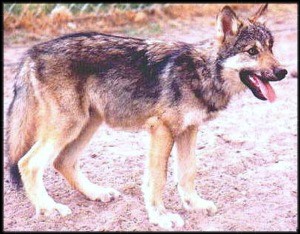
Here is a photo of a
high content Wolfdog
that is not quite 4 months old (right),
next to an adult animal with Liver Shunt
(left).
Photo © Skylar |
Testing: Bloodwork is looked at for
abnormalities that indicate poor liver function.
X-rays of the abdomen also may show a small,
undeveloped liver. Blood ammonia concentration can
also be measured; this test will diagnose liver
disease in 90% of affected animals. It is more
accurate (95 to 100%) if an ammonia challenge is
done
An accurate test for bile acid concentrations can
be done on 6-8 week old puppies to indicate the
presence of liver disease.
A blood sample is taken after a 12 hour fast, and
then the puppy is fed a normal meal. Two hours
later another blood sample is taken. Bile acid
concentrations are high in most types of liver
disease, including shunts.
When Liver Shunt is suspected, further testing
such as ultrasound or surgery may be needed to
confirm and identify the type of shunt.
The pancreas has 2 functional parts. The
"exocrine" is the part of the pancreas
tissue that produces enzymes used to digest food,
and the "endocrine" which secretes
hormones such as insulin and glucagon.
It is important contact your vet for proper
diagnosis of illness. When the pancreas becomes
inflamed, the disorder is called pancreatitis. It
is a disease process that is seen commonly in the
dog. There is no age, sex, or breed
predisposition.
Pancreatitis consist of two main forms; The mild
sudden onset and the more acute, hemorrhagic form.
Some dogs that recover from an acute episode may
continue to have recurrent bouts, known as
chronic, relapsing pancreatitis. The
associated inflammation allows digestive enzymes
to spill into the abdominal cavity; this may
result in secondary damage to surrounding organs,
such as the liver, bile ducts, gall bladder, and
intestines.
An unbalanced diet, medication, and reflux of
bile acids and bacteria from the duodenum into the
pancreas, can all contribute to pancreatitis, the
cause is not known and cases need to be carefully
assessed for any identifiable causes. Under normal
conditions, digestive enzymes produced by the
pancreas are activated when they reach the small
intestines. In pancreatitis, these enzymes
are activated prematurely in the pancreas instead
of in the small intestines. This results in
digestion of the pancreas itself. The disease
is typically manifested by nausea, vomiting,
fever, abdominal pain, and diarrhea. If the
attack is severe, acute shock, depression, and
death may occur.
If a significant number of cells that produce
digestive enzymes are destroyed, a lack of proper
food digestion may follow. If a significant number
of cells that produce insulin are destroyed,
diabetes mellitus can result. In rare cases,
adhesions between the abdominal organs may occur
as a consequence of pancreatitis.
Pancreatic enzyme deficiency or Exocrine
Pancreatic Insufficiency (also called “Maldigestion”)
Enzymes break down nutrients which are
digested and then absorbed. Without adequate
productive of these enzymes, we cannot digest our
food. If we cannot digest the food, we cannot
absorb the food. The pancreas gradually becomes
shriveled and useless (atrophy).
This condition is not congenital (present at
birth) and may develop at any age (though usually
shows up before age 4 years). About 70% of dogs
with exocrine pancreatic insufficiency are German
Shepherd dogs and 20% are Rough Collies.
Mode of inheritance: appears to be autosomal
recessive and involves immune-mediated
destruction of the pancreas.
Breeding Advise: Affected dogs, and in
German shepherds, their parents (considered
carriers) and siblings (suspect carriers) should
not be used for breeding.
Symptoms: Affected
dogs progressively lose weight despite voracious
appetites. Stools have an unusual odor, and these
animals usually pass large amounts of semi-formed
feces, or greasy diarrhea. Often owners complain
of Coprophagy (Feces
Ingestion). A dog might also develop a
dry/dandruff coat and/or brittle and coarse hair
from inability to absorb dietary fats.
Testing: A TLI blood test is available (The
Serum Trypsin-like Immunoreactivity test). The
test looks for a normal level of trypsin-like
enzymes in the bloodstream. A dog with
enzyme deficiency (EPI) will have abnormally low
levels. The dog must be fasted for the test to be
accurate but only a single blood sample is needed
to make the diagnosis. This test is often
combined with serum folate and cyanocobalamin
(Vitamin B12) testing since these can help
determine how severe the defiency is and also help
sort our other inflammatory bowel diseases that
might be present.
Thyroid
(hyper or hypo)
Hyperparathyroidism - High thyroid
levels.
Associated with cancer, It is unusual for dogs to
have hyperthyroidism, which is more common in
cats.
Hypothyroidism - Too low a level of
thyroid hormone in the body.
There are two forms of hypothyroidism in dogs. In
one, more common form, (autoimmune or lymphocytic
thyroiditis) the immune system attacks the thyroid
gland. In the second form, the gland seems to
atrophy for other reasons.
The disorder may be acquired (most common) or
congenital, and can be difficult to diagnose.
Acquired hypoyhyroidism is genrally seen in middle
aged (4-10 yrs) medium to large breed dogs.
Congenital hypothyroidism is very rare, puppies
will have stunted growth as well as many other
abnormalities. Severely affected puppies most
likely die before weaning..
Mode of inheritance: Is unknown
Breeding advise: Although inheritance of
this disorder has not been determined, it is
advisable not to breed affected dogs
Symptoms: Hyperparathyroidism
HPT can cause loose teeth, brittle bones, and
kidney damage.
With Hypothyroidism,
symptoms can begin with loss or thinning of
the fur, dull hair coat, excess shedding or
scaling, weight gain, lower energy levels,
increased susceptibility to infections and
intolerance to cold. As the disease progresses,
slow heart rate, lethargy, infertility, and
constipation. The accumulation of substances
called mucopolysaccharides can cause the muscles
of the face to droop giving the dog a facial
expression that is sometimes called “tragic”.
Back to Top
A hernia which can be pushed back into the
abdomen is called reducible.
Hernias which are not reducible are called incarcerated.
If the blood supply to an incarcerated hernia is
pinched off the hernia becomes strangulated.
A strangulated hernia is an emergency situation
and must be brought to the immediate attention of
your veterinarian.
An umbilical hernia is a swelling in the
center of the abdomen, caused be a small opening
in the muscle where the umbilical cord was
attached, this results in malplacement of abdominal
organs. In
most cases umbilical hernias are small and reduce
as the puppy grows. Generally, by the time the pup
is six months old the umbilical hernia will shrink
and disappear on its own. If the pup has a large
hernia, or one that can be pushed into the abdomen
with a finger, consult your veterinarian regarding
possible surgical repair.
Inguinal hernias are found in the groin
area and can be located on both sides of the
groin. They can occur in both male and female
dogs, but are more common in females. As with
umbilical hernias most inguinal hernias will
shrink and disappear as the puppy grows, although
you must keep an eye on the size of the hernia(s).
Diaphragmatic hernias are the result of a
tear in the diaphragm which allows abdominal organ
portions to pass into the chest area. Most common
occurrence is following an accident.
Mode of inheritance: Umbilical
hernias are recessive,
polygenic.
Breeding Advise: Umbilical
hernia - It is recommended that any
dog with it should be spayed/neutered, however,
the umbilical hernia can also be caused by the
mother as she tries to clean up the cord area on
her new pup.
Dogs affected by an inguinal
hernia should not be bred..
|

|
|
Photo ©
Pam Thompson |
The way teeth align with each other is termed
occlusion. Malocclusion refers to abnormal tooth
alignment, a condition where the teeth do not meet
in a proper scissors bite. Sometimes found in
Arctic Wolfdogs, exhibiting a overshot or
undershot jaw.
Undershot jaw - Abnormality of the skull
where the upper jaw is too short for the rest of
the head (when the lower teeth protrude in front
of the upper jaw teeth).
Overshot jaw - Abnormality of the skull
where the upper jaw is too long for the rest of
the head. (The lower jaw shorter than the upper)
level bite - If the upper and lower incisor
teeth meet each other edge to edge, the occlusion
is an even or level bite.
Open bite - When the upper and lower
incisors do not overlap or even meet each other
when the mouth is closed..
Anterior crossbite - occurs when the canine
and premolar teeth on both sides of the mouth
occlude normally but one or more of the lower
incisors are positioned in front of the upper
incisors. Anterior crossbite is the most common
malocclusion. If there is an anterior crossbite
there must be a condition termed posterior
crossbite.
Posterior crossbite - occurs when one or
more of the premolar lower jaw teeth overlap the
upper jaw teeth. This is a rare condition that
occurs in the larger-nosed dog breeds.
A wry mouth - or bite occurs when one side
of the jaw grows longer than the other.
Base narrow - canines occur when the lower
canine teeth protrude inward and can damage the
upper palate. Often this condition is due to
retained baby teeth.
Mode of inheritance: Undershot/overshot
jaw is a recessive
trait. Anterior crossbite,
is not considered genetic or hereditary. A wry
mouth is considered hereditary.
Cryptorchidism is a condition in which the
testes fail to descend into the scrotum. The dog
so afflicted is called a cryptorchid. If one
testicle is retained, he is unilateral
(one-sided), if both are affected, a bilateral
cryporchid. Two conditions that can be verified
only through extensive surgery are a monorchidism,
which is the rare presence of only one testicle
ANYWHERE in the body, and anorchids which are
males with no testicles.
The time it takes for the testes to migrate to
the scrotum can vary from individual to
individual, however, on the average, the testes
are completely descended within 10 to 14 days
following birth. Absence of one or both testes in
the scrotum by 8 weeks of age warrants a diagnosis
of cryptorchidism and it is supposed to be highly
unlikely that testicles will descend if they can
not be found outside the body wall by around four
months of age. In only a minority of dogs, does
descent occur as late as 6 months, and this
variation is considered suspect of a developmental
abnormality.
Breeding advise: Sperm production will
occur in the descended testis of unilateral
cryptorchids. But because of the genetic basis, an
increased risk for testicular cancer, and
testicular torsion, generally bilateral castration
(orchidectomy) is recommended.
Mode of inheritance: Cryptorchidism is
inherited as a sex-limited
autosomal recessive trait.
Testing: Palpation of the scrotum provides
evidence of the presence or absence of two testes
I recently had a visit with a high content Wolfdog
who had a black spot on it's tongue. Having never
seen this before, and always wanting to learn
more, I decided to do some research into this and
thought I would share it here (even though I
wouldn't call it a disorder, so I added the
"etc").
It seems this is something that appears in WD's as
well as in pure's, and is generally thought of as
similar to a beauty mark on a person.
I wondered if this would be considered a fault
in any of the dog breeds. Personally I would not
prefer this in one of my animals for two reasons:
-
People believing that the black spot means
the animal is a chow cross.
-
It can be visually distracting.
I wrote to a friend who has helped with my
questions in the past, and was told:
-
They are not considered a fault in most show
rings. Although I did find that the official
U.K.C. Breed Standard for Jindo dogs states,
"The tongue is large and deep pink
without any spots". Also C.K.C Akita
Breed Standard, "No black spots on
tongue".
-
There are a couple of theories as to the
cause...
-
There are Germ cells (egg/sperm -
reproductive cells) and Somatic cells (any
other cell in the body). The most likely cause
of this spot I was told, is a somatic mutation
(permanent change or structural alteration in
the DNA) of the recessive yellow gene - to
black. Sometimes for the same reasons, this
may also affect the coat. The size of the spot
usually has to do with when in the development
the mutation occurred. If early and that group
of cells continued to split and grow, then you
can get a fairly large spot. If late, it will
be a small spot or perhaps just a hair or two.
-
The other theory is that it occurs from the
melanocytes (A pigment-producing cell in the
skin, hair and eye that determines their
color) migrating away from the neural crest
(where melanocytes originate) during
development..
The following is a list of known purebreds with
black pigmentation on their tongues...
Labrador
Retriever, Golden Retriever, Newfoundland,
Samoyed, German Shepherd, Aussies,
Akita, Belgian Sheepdog, Collie, Tervuren, Malinois, Fila Brasileiro, Cairn Terrier, Great
Pyrenees, Keeshond, Airedale, Doberman Pinscher,
Bouvier de Flandres, Australian Shepherd, Australian Cattle Dog, Pug, Shiba Inu, Dalmatian,
Flat-coated Retriever, Gordon Setters, Shar-Pei,
Cocker Spaniel, Siberian Husky,
Rottweiler, Rhodesian Ridgeback, and of course the
Chow.
If the allele is dominant,
only 1 copy is required to express the trait; if recessive
then 2 copies are required to express the trait.
Upper case letters are traditionally used to
represent dominant traits. Thus for a dominant
trait, either AA or Aa will express the particular
characteristic.
Lower case letters for recessive traits. For a
recessive trait only aa will express the
characteristic. The heterozygote (Aa) will be a
carrier - clinically unaffected but able to pass
the harmful allele to the offspring.
Example:
(From website linked
at the bottom of this page)
Progressive retinal atrophy (PRA) causes
blindness in many breeds. P represents the
dominant allele, and p the recessive allele.
Since PRA is a recessive trait, p is the
affected allele, and P the normal allele.
The genotypes PP and pp are homozygous. Dogs
with the genotype PP have normal sight and those
with pp are affected.
Pp is heterozygous. These animal have normal
sight but are carriers. They will pass the
allele for progressive retinal atrophy to
approximately half their offspring.
Phenotypically, both PP and Pp have normal
sight, but their genotype is different. At this
time, as with most recessive disorders, there is
no way to identify carriers (animals with the
genotype Pp) until affected offspring are born.
Autosomal
recessive -
The most common mode of inheritance for genetic
conditions in dogs.
To be affected, the animal must inherit (genotype
pp) 2 copies of the affected gene, 1 from each
parent.
Puppies that inherit genotype PP will be normal
Puppies that inherit genotype Pp will be normal,
but will be carriers.
As long as carriers (Pp) are mated to normal
animals (PP), the offspring will be unaffected but
some will remain carriers.
If 2 carriers are mated, some of the offspring
(approximately 25%) will be affected.
The odds increase if one were to breed a parent
affected with the disorder (pp) to a carrier (Pp).
In such a situation, there is a 50% risk that the
offspring will be affected (any unaffected
offspring will be carriers)
In contrast, if one parent is affected (pp) and
the other is neither affected nor a carrier (PP),
none of the children will be affected with the
disorder. However, all will be carriers.
Sex-limited - In these traits, the gene
is located on the X chromosome.
Males have X (chromosome from Dam) & Y
(chromosome from Sire) = XY which simply means
they are male.
Females have X (chromosome from Dam) & X
(chromosome from Sire) = XX
So if a mother who is a carrier for a harmful
recessive gene (Xx) passes the recessive gene (x)
to her daughter, the daughter will be an
unaffected carrier, but her sons who receive that
gene will be affected.
Polygenetic - Scientists do not yet know
which genes are involved, or how many genes. The
gene expression is influenced by a variety of
factors including gender, nutrition, breed, rate
of growth, and amount of exercise.
These traits are quantitative traits - that is,
there is a wide range within the population. Such
traits include height, weight, character, working
abilities, and some genetic defects. Heritability
varies within different breeds and within
different populations of a particular breed.
For
more information, please visit the website below