|
DNA Paternity Testing
|
© By
Cottonwoods Kennel
Previous printed version edited by Kim
Miles
|
|
|
A breeder once told me that even though
there were two males in a pen with one of his females, he
could distinguish which was the sire just by looking at
the pups. If faced with the possibility of two sires, what
would you do? Could you tell which one was the sire? This
year, something similar, yet unintentional, happened to
us.
 In the past, I would roll my eyes whenever I heard someone
say they had an "accidental" litter. I
couldn’t help but think, “You have a female in heat...
she's in with a male. Ok, where's the
"accident?".
In the past, I would roll my eyes whenever I heard someone
say they had an "accidental" litter. I
couldn’t help but think, “You have a female in heat...
she's in with a male. Ok, where's the
"accident?".
My thoughts have become a little more
"generous", or understanding because of what
happened to us this year.
Our
animals normally breed during mid-February, so we separate
the males and females during the last part of January.
This has worked for many years with no mishaps. However,
this year, on January 16th a commotion led me to the front
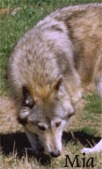
kennel where Mia and Ash were tied. Mia had exhibited no
signs of bleeding, swelling or any indication of a
willingness to mate.

We moved her immediately, calling our vet and asking him
what our best options were. He advised against any medical
action concerning the potential pregnancy. Although we
anticipated that she might be pregnant, all we could do
was simply hope that she was not — but prepare as if she
was. We were pretty sure Ash, the alpha male, would be the
sire sense we had seen him in a tie with Mia. From what we
had observed, Maverick, the beta male, had shown no
interest in Mia and he also seemed to be sufficiently
cowed by the alpha. Although there was a chance that
Maverick 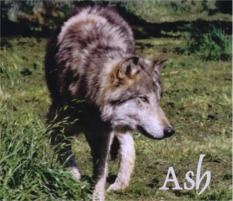 could have bred Mia, all indications pointed to Ash.
It
was not long before we had our answer, Mia was definitely
pregnant and we were going to be having our first
“accidental” puppies. We were now faced with a big
question: “Who’s the sire?” We just “knew” that
it would be Ash, but couldn’t rule out Maverick, the
second male in the pen, as a possible (or even a multiple)
sire. Although we had not seen them mate, we couldn’t be
100% sure that such a mating did not occur; and while
multiple-sired litters (i.e., litters with more than one
father) are less common when it comes to these canines,
they can and do happen. With our dogs we felt there was
only one course of action: DNA profiling of the dam,
possible sires and all of the puppies. |
|
|
|
DNA PROFILING: The
last five years has seen a sharp rise in DNA profiling for
verifying paternity, and there are several labs to choose
from, some of which are listed below.
These labs send out swab test kits free of charge, along
with detailed instructions. In the test kits, nylon
bristle swabs for sample collection seem to be the most
commonly used collecting tool, although foam swabs are
also available.
The sample collection
method is non-invasive (i.e. no blood or hair bulb tissue
is needed). The nylon bristle swab or the foam swab is
inserted into the animal’s mouth between the gum and the
cheek, where it collects loose check cells. The swab is
then packaged and mailed back to the lab. DNA profiling is
used on pets for identification and to verify ancestry.
According to Genomic, a company specializing in DNA
profiling, true parentage can be detected even within
highly inbred lines to a reported accuracy of 99.8 %. Once
the test is completed, a certificate is mailed to the
owner, reporting the dog’s DNA profile in an
alphanumeric code sequence and a color bar code.
For Wolfdog owners: Our veterinarian assisted us in
searching for a competent lab that would perform DNA
profiling on Wolfdogs. He contacted one lab that
immediately hung up on him after he mentioned the word
“wolfdog.” However, I was a little more successful,
the labs I called were very willing to accept them.
List
of Labs contacted concerning
DNA testing |
|
|
THE PUPPIES
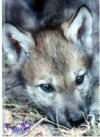
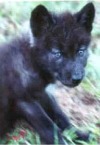
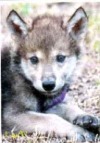
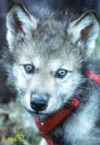
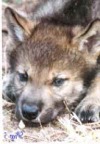
Mia gave birth to five healthy puppies in March.
One was black, like Maverick, and four were brown. Our
puppies are born dark—and lighten in color as they age.
Brown puppies generally become agouti or
"grizzled" in color, which is the coloration of
both Mia and Ash. My husband was sure that the black pup
(#2) would be Maverick’s and that the remaining puppies
in the litter would be Ash’s. On the other hand, I
thought two pups would be Maverick’s (the black one and
one other) and that the remaining puppies would be
Ash’s. To our complete surprise, none of the puppies
were sired by Ash - even though we had seen Mia and
Ash copulate. All of the puppies were sired by Maverick.
(He must have been sneaking around in the dark :-) As
a side note, one of the puppies is the image of Ash!
This only reaffirms my personal thoughts on the
breeder’s comments posted at the beginning of this
article; one can only question all of the pedigrees of
puppies he produced with more than one male present during
breeding season.
Registering animals and documenting lineage is
worthwhile, but this, alone, should not be considered
“verified.” My situation has caused me to do a lot of
thinking about taking advantage of the genetic testing
services that are now available—both for identification,
and for the assurance of my puppies new owners.
|
|
|
|
Example
|
|
Two versions of genetic alleles are found at each
site examined. One of the alleles is inherited from the sire, the
other from the dam. Labs use letters of the alphabet to represent
each known allele.
Parentage verification is done by checking to
see if the letters at each site in the pup, can be formed by
selecting one allele from each of the parents.
If a sire with alleles BG at the second marker
mates with a dam with alleles PS at the second marker, they can
produce offspring with alphabetic combinations at the second
marker of: BP, PG, BS, SG.
If the puppy in question has one of those
combinations, it's called an inclusion
If the puppy does not have one of those combinations, it's called
an exclusion
|
| Sire |
AA |
BG |
DK |
BC |
AT |
SS |
RY |
CD |
KM |
AJ |
| Pup 1 |
AB |
BP |
DK |
CL |
NT |
PS |
AR |
DP |
MN |
JQ |
| Dam |
BZ |
PS |
KK |
LS |
MN |
PD |
AH |
PO |
MN |
QR |
|
Excluded
Male |
FZ |
TS |
AK |
CL |
MA |
DS |
YH |
PO |
NK |
AR |
|
|
|
If you would like to
link to this page you can use the image below...
|
|
|


|
© Cottonwood
Kennel All Rights Reserved |
|